DinoVerse · Dinosaur fact sheet
Styracosaurus
Say it: sty-RAK-oh-SORE-us · Name means: “Spiked lizard”
| ⏳ Lived | 75.5–74.5 million years ago Late Cretaceous |
|---|---|
| 🌿 Diet | Herbivore (plant-eater) |
| 📏 Length | 5–5.5 m (16–18 ft) |
| ↕️ Height | 1.6–1.8 m (5–6 ft) |
| ⚖️ Weight | 1,800–2,700 kg (3,970–5,950 lb) |
| 📍 Found in | North America |
| 🔎 Discovered | 1913 by Lawrence Lambe (fossil found by Charles M. Sternberg) |
About Styracosaurus
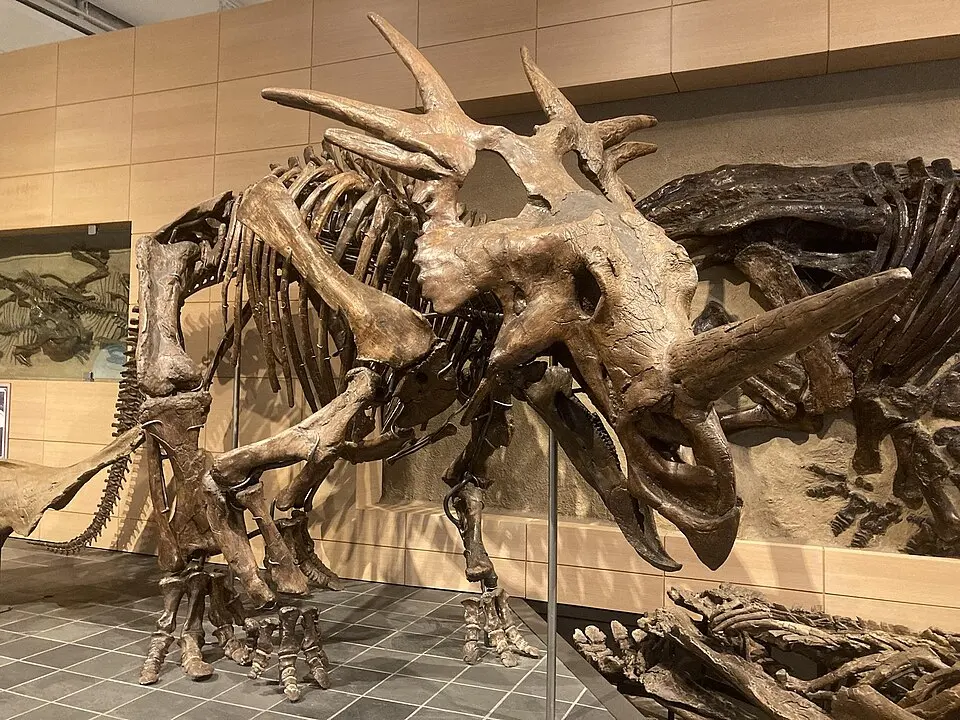
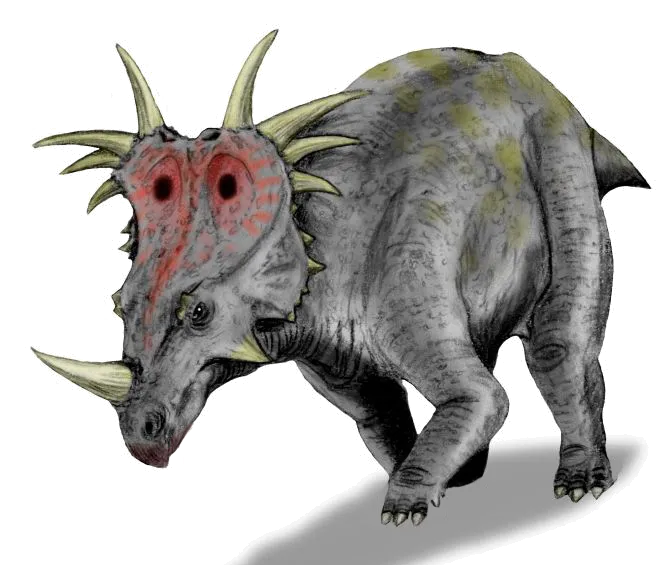
Styracosaurus had one long horn on its nose and a crown of long spikes around its frill. It was a rhino-sized plant-eater.
Styracosaurus was a centrosaurine ceratopsid from the Dinosaur Park Formation of Alberta. It is famous for a tall nasal horn and four to six long spikes projecting from the back of its frill, structures that most likely worked as display signals.
How big was it?
Drawn to scale next to a 1.7 m adult and a 12 m school bus.
Did you know?
- The longest spikes on its frill were about half a metre long — as long as a baseball bat is to a small kid!
- Its nose horn was about as long as your leg from knee to foot.
- Styracosaurus was about the size of a big rhino.
- No two Styracosaurus had exactly the same pattern of frill spikes.
- Its frill spikes and nasal horn were probably too thin and spread out to be very useful against predators, so most researchers interpret them as display features for attracting mates or recognising its own species.
- A well-preserved skull nicknamed 'Hannah', described in 2020, showed that frill spikes varied between individuals and could even differ between the left and right sides of one animal.
- Bonebeds containing several Styracosaurus hint that it lived in groups, although the evidence is not as strong as the huge bonebeds known for Centrosaurus.
- Styracosaurus shared its habitat with several other horned dinosaurs, such as Centrosaurus and Chasmosaurus, which may have avoided competition by living in slightly different times or places.