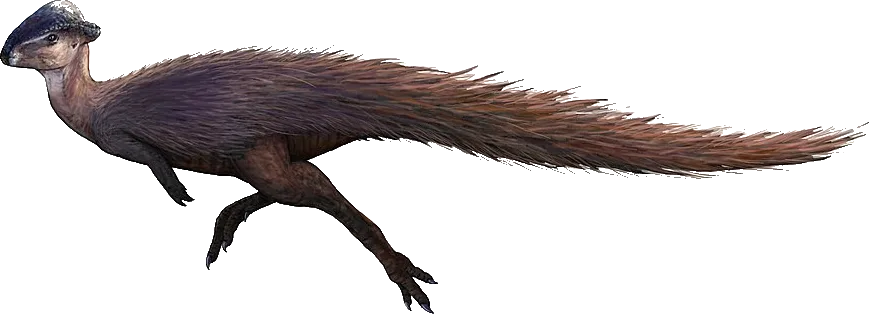
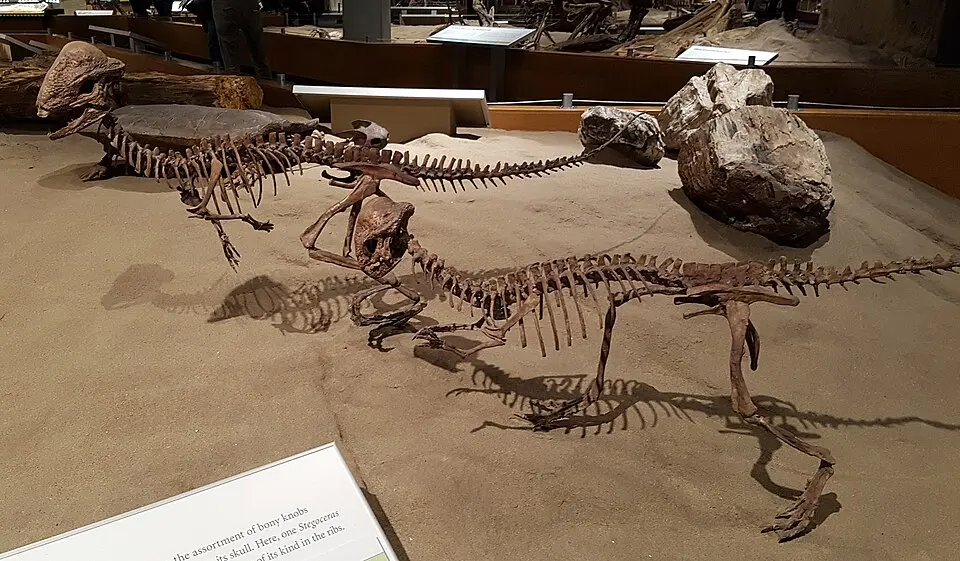
Stegoceras was a small dome-headed dinosaur about the size of a big dog. It had a rounded, thick bony top to its head.
Stegoceras validum was a small pachycephalosaurid from the Late Campanian of Alberta, and one of the best-known dome-headed dinosaurs thanks to a nearly complete skull and partial skeleton. Its thickened skull roof has made it a key species in the debate over whether pachycephalosaurs butted heads.
Drawn to scale next to a 1.7 m adult and a 12 m school bus.
Did you know?
Stegoceras was only about as heavy as a big dog!
Its head had a smooth, thick dome of bone, a bit like a built-in helmet.
The scientist who first found its dome thought it was a horn from a dinosaur's nose.
It ran around on two legs and ate plants.
Lawrence Lambe named Stegoceras in 1902 from isolated domes; unsure what they were, he suggested they sat in front of the nose, and the idea of a 'unicorn dinosaur' was briefly floated.
In 1924 Charles Gilmore merged Stegoceras with Troodon because their teeth looked similar; later work showed Troodon was a theropod, and the two were separated again.
Computer models of its skull bone (2008) suggest the dome could withstand head-butting impacts, but whether it butted heads, flanks or simply displayed its dome is still debated.
Domes from juveniles are flatter, showing that the dome grew taller and thicker with age.
DinoVerse· Stegoceras fact sheet
Pachycephalosaurs
🌿 What did it eat?
Food: Leaves of flowering shrubs, Seeds and fruits, Ferns, Low conifers.
Picked leaves, seeds and fruit with a narrow beak and sliced them with small, serrated, leaf-shaped teeth; it fed close to the ground on low plants.
Clues scientists use: small serrated leaf-shaped teeth; tooth wear; narrow snout for selective feeding.
Who might have hunted it: Gorgosaurus, Daspletosaurus, Saurornitholestes.
🗺️ Where fossils were found
Dinosaur Provincial Park, Alberta, Canada (North America)
Oldman Formation, southern Alberta, Canada (North America)
Skeleton / museum mount of Stegoceras: Royal Tyrrell Museum Stegoceras
Myth or fact?
✗ Myth: Stegoceras's dome was a horn on its nose.
✓ Fact: Its first discoverer only had loose domes and wondered if they were nose horns. A complete skull later showed the dome was the roof of the skull.
✗ Myth: Dome-headed dinosaurs definitely charged head-first like rams.
✓ Fact: Scientists still debate how they used their domes. They may have butted each other's sides, used the dome for display, or both.
✏️ Quick quiz
Circle the right answer. Name: ______________________
About how heavy was Stegoceras?
A As heavy as a bus
B As heavy as a big dog
C As heavy as a mouse
D As heavy as an elephant
In which country was Stegoceras found?
A Brazil
B Egypt
C China
D Canada
What did Lambe first think Stegoceras's dome might be?
A A nose horn
B An egg
C A tooth
D A tail club
Answers: 1–B 2–D 3–A
Sources and picture credits
Natural History Museum London — Stegoceras — www.nhm.ac.uk/discover/dino-directory/stegoceras.html
Wikipedia — Stegoceras — en.wikipedia.org/wiki/Stegoceras
 DinoVerse · Dinosaur fact sheet