DinoVerse · Dinosaur fact sheet
Spinosaurus
Say it: SPY-no-SORE-us · Name means: “Spine lizard”
| ⏳ Lived | 99–93 million years ago Late Cretaceous |
|---|---|
| 🐟 Diet | Piscivore (fish-eater) |
| 📏 Length | 12–15 m (39–49 ft) |
| ↕️ Height | 3–4 m (10–13 ft) |
| ⚖️ Weight | 6,000–8,000 kg (13,230–17,640 lb) |
| 📍 Found in | Africa |
| 🔎 Discovered | 1912 by Richard Markgraf (named by Ernst Stromer in 1915) |
About Spinosaurus
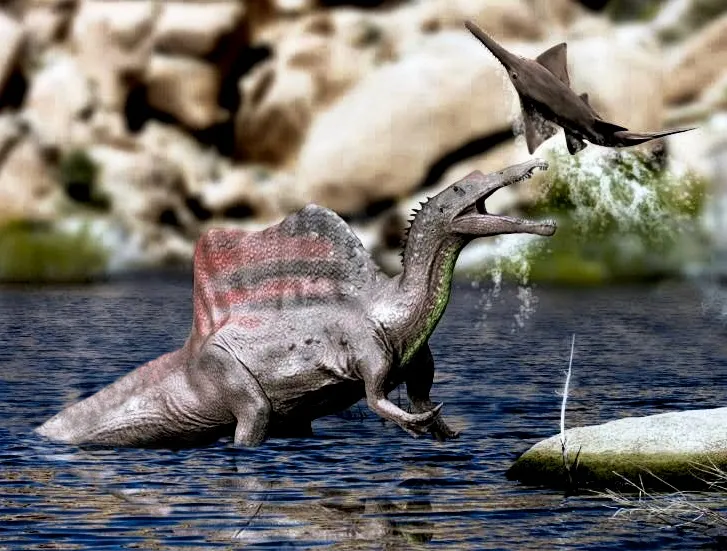
Spinosaurus was a giant fish-eating dinosaur with a huge sail on its back. It spent lots of time in rivers, a bit like a crocodile.
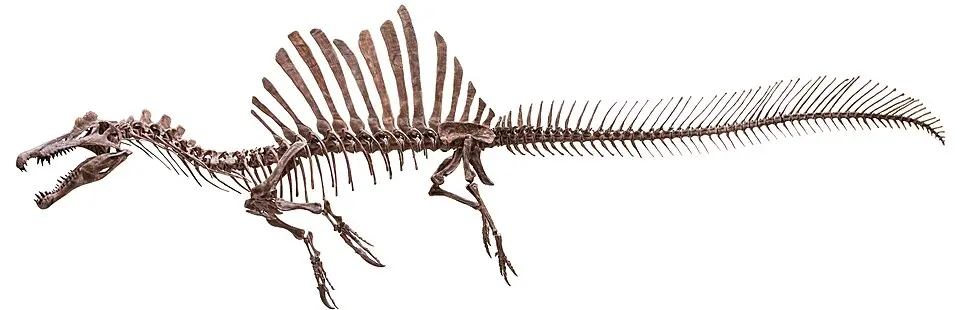
Spinosaurus aegyptiacus was a spinosaurid theropod from the river systems of North Africa about 99 to 93 million years ago, and one of the longest known predatory dinosaurs. Its tall back sail, dense bones, short hind legs and paddle-like tail point to a life closely tied to water, though exactly how well it swam is still argued over.
How big was it?
Drawn to scale next to a 1.7 m adult and a 12 m school bus.
Did you know?
- Spinosaurus was even longer than T. rex, about as long as a school bus and a car put together!
- The sail on its back was held up by spines taller than a grown-up person.
- It loved eating fish, including sawfish bigger than a car.
- The very first Spinosaurus fossils were destroyed by a bomb in World War II, so scientists had to find new ones.
- The original specimen described by Ernst Stromer was destroyed in a 1944 Allied bombing raid on Munich, so for decades Spinosaurus was known mostly from Stromer's drawings and notes.
- A 2020 study of a partial skeleton from Morocco described tall, flexible tail spines that formed a fin-like paddle, which its authors argued powered swimming through water.
- Scientists still debate how aquatic it was: a 2022 bone-density study suggested it hunted underwater, while other teams argue it was a 'giant heron' that waded in shallows and could not dive well because its sail made it unstable in deep water.
- Its nostrils sat far back on the snout and the jaw tip had small pits that may have held pressure sensors, features also seen in fish-hunting crocodiles.
- Spinosaurus shared its rivers with other big predators such as Carcharodontosaurus, so eating mostly fish may have helped it avoid competing with them.