Say it: PRO-toe-SERR-uh-tops · Name means: “First horned face”
Key facts about Protoceratops
⏳ Lived
75–71 million years ago Late Cretaceous
🌿 Diet
Herbivore (plant-eater)
📏 Length
1.8–2.5 m (6–8 ft)
↕️ Height
0.6–0.7 m (2 ft)
⚖️ Weight
60–180 kg (130–400 lb)
📍 Found in
Asia
🔎 Discovered
1922 by Walter Granger and the American Museum of Natural History Central Asiatic Expedition
About Protoceratops
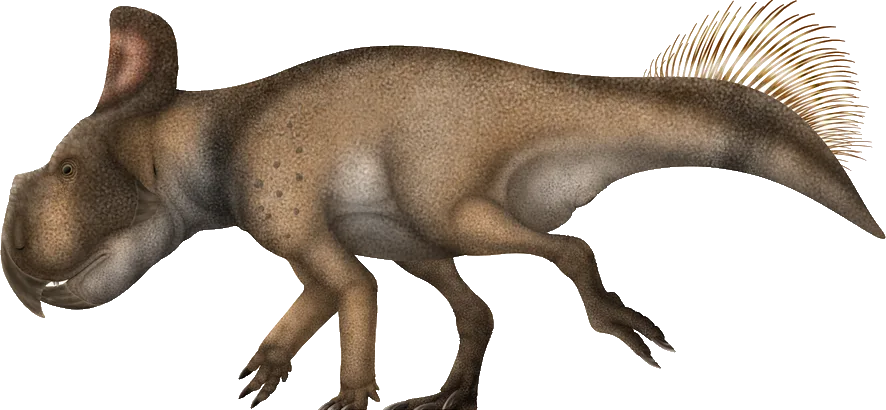
Protoceratops was a sheep-sized horned dinosaur with a frill but no real horns. It lived in the deserts of Mongolia.
Protoceratops was a small, early-branching ceratopsian from Late Cretaceous Mongolia and northern China. Known from hundreds of specimens, from hatchlings to adults, it is one of the best-understood dinosaurs and is famous for the 'Fighting Dinosaurs' fossil locked in combat with Velociraptor.
Drawn to scale next to a 1.7 m adult and a 12 m school bus.
Did you know?
Protoceratops was about the size of a sheep.
One famous fossil shows a Protoceratops and a Velociraptor frozen in the middle of a fight!
Scientists have found lots of Protoceratops, from tiny babies to grown-ups.
Its eggs had soft, leathery shells, a bit like a turtle's eggs.
The 'Fighting Dinosaurs' specimen, found in 1971, preserves a Velociraptor with its claw in the Protoceratops' neck while the Protoceratops bites its arm; both were probably buried by a collapsing sand dune or sandstorm.
A 2020 study of Protoceratops embryos found that their eggs were soft-shelled, suggesting that hard-shelled eggs evolved more than once among dinosaurs.
Because so many individuals are known, researchers have tracked how the frill and skull changed with age; frill size differences between adults may reflect differences between males and females, though this is debated.
A nest of 15 juveniles found together suggests young Protoceratops stayed together, perhaps with some parental care.
Cropped tough, woody plants with a deep, sharp beak and chopped them with rows of shearing cheek teeth, helped by strong jaw muscles anchored on its frill.
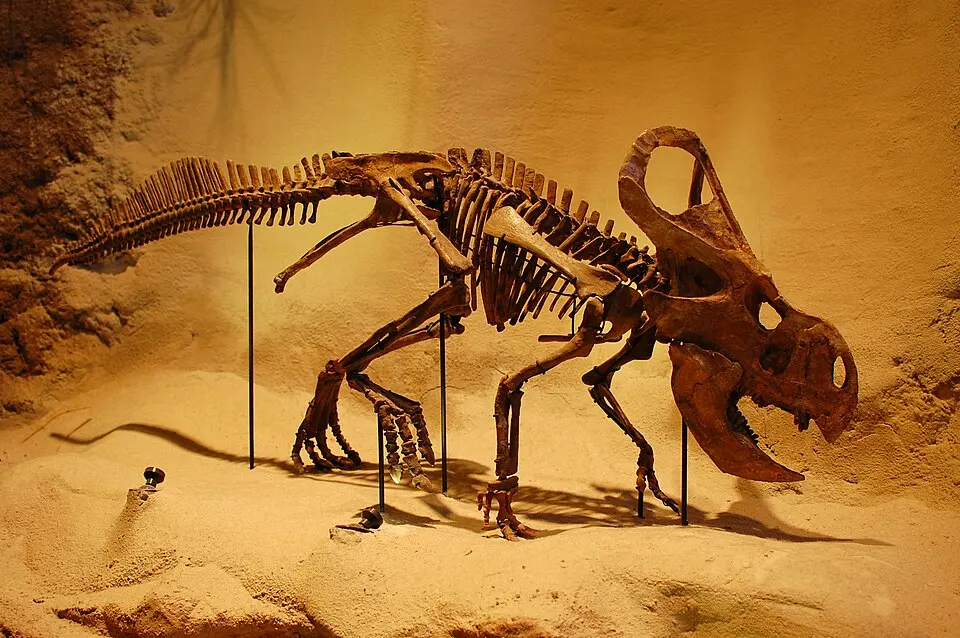
Skeleton / museum mount of Protoceratops: Protoceratops andrewsi skeleton at Carnegie Museum of Natural…
Myth or fact?
✗ Myth: Ancient people found Protoceratops skulls and invented the griffin legend from them.
✓ Fact: This is a popular idea, but a 2024 review found little real evidence for it: griffin art and stories do not match Protoceratops skeletons well, and griffins appeared in art long before trade routes reached its fossil beds.
✗ Myth: The famous eggs found in the 1920s were Protoceratops eggs, and Oviraptor was stealing them.
✓ Fact: In the 1990s embryos showed those eggs belonged to Oviraptor-like dinosaurs, which were sitting on their own nests.
✏️ Quick quiz
Circle the right answer. Name: ______________________
About how big was Protoceratops?
A Size of a school bus
B Size of a house
C Size of a sheep
D Size of a mouse
Which dinosaur is it fighting in the famous 'Fighting Dinosaurs' fossil?
A Tyrannosaurus rex
B Velociraptor
C Triceratops
D Stegosaurus
Where have most Protoceratops fossils been found?
A Mongolia
B Australia
C England
D Argentina
Answers: 1–C 2–B 3–A
Sources and picture credits
Natural History Museum London — Protoceratops — www.nhm.ac.uk/discover/dino-directory/protoceratops.html
Wikipedia — Protoceratops — en.wikipedia.org/wiki/Protoceratops
Wikipedia — Griffin — en.wikipedia.org/wiki/Griffin
 DinoVerse · Dinosaur fact sheet