Say it: PLAT-ee-oh-SORE-us · Name means: “Broad lizard”
Key facts about Plateosaurus
⏳ Lived
214–204 million years ago Late Triassic
🌿 Diet
Herbivore (plant-eater)
📏 Length
5–10 m (16–33 ft)
↕️ Height
2–3 m (7–10 ft)
⚖️ Weight
600–4,000 kg (1,320–8,820 lb)
📍 Found in
Europe, North America
🔎 Discovered
1834 by Johann Friedrich Engelhardt (named by Hermann von Meyer, 1837)
About Plateosaurus
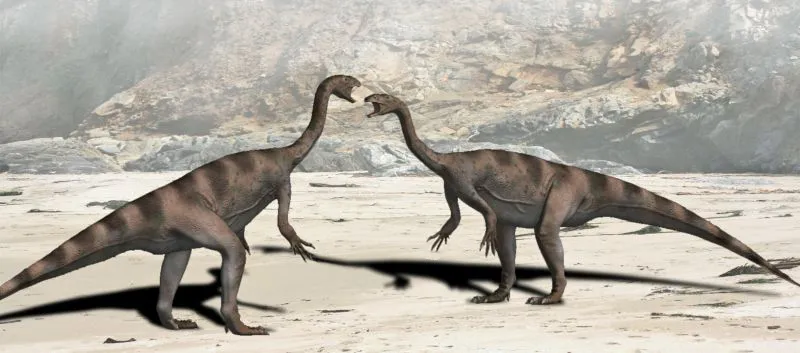
Plateosaurus was an early long-necked plant-eater that walked on two legs. It lived over 200 million years ago, near the start of the age of dinosaurs.
Plateosaurus was a plateosaurid sauropodomorph from the Late Triassic of central and northern Europe, and one of the best-known early dinosaurs from dozens of skeletons. It was a bipedal plant-eater and an early relative of the giant sauropods, though not their direct ancestor.
Drawn to scale next to a 1.7 m adult and a 12 m school bus.
Did you know?
Plateosaurus walked on its back legs, even though it was as long as a bus.
Its hands had big claws that may have helped it grab branches and protect itself.
Lots of Plateosaurus skeletons have been found in one German town called Trossingen.
Some grown-up Plateosaurus were small and some were huge, like people of different heights.
Studies of its arm bones in 2007 showed Plateosaurus could not turn its palms to face the ground, so it could not walk on all fours and was a full-time biped.
Unusually for a dinosaur, it showed strong developmental plasticity: fully grown adults ranged from about 5 to 10 m long and 600 to 4,000 kg, perhaps depending on food supply and climate.
Many skeletons at Trossingen and Frick appear to belong to individuals that became stuck in soft mud and died, rather than herds killed together by a single disaster.
Its leaf-shaped teeth are strongly plant-adapted, but a few scientists have suggested early sauropodomorphs may have eaten small animals now and then; the evidence for that is weak.
Walked on its hind legs and used its long, flexible neck and clawed hands to reach and pull down plants, slicing them with leaf-shaped, coarsely serrated teeth.
Clues scientists use: leaf-shaped serrated teeth like those of modern plant-eating lizards; low jaw joint that gave a strong, scissor-like bite; tooth wear; long neck for reaching high vegetation.
Who might have hunted it: Liliensternus.
🗺️ Where fossils were found
Trossingen, Baden-Württemberg, Germany (Europe)
Frick, Aargau, Switzerland (Europe)
Halberstadt, Saxony-Anhalt, Germany (Europe)
Fleming Fjord Formation, East Greenland (North America)
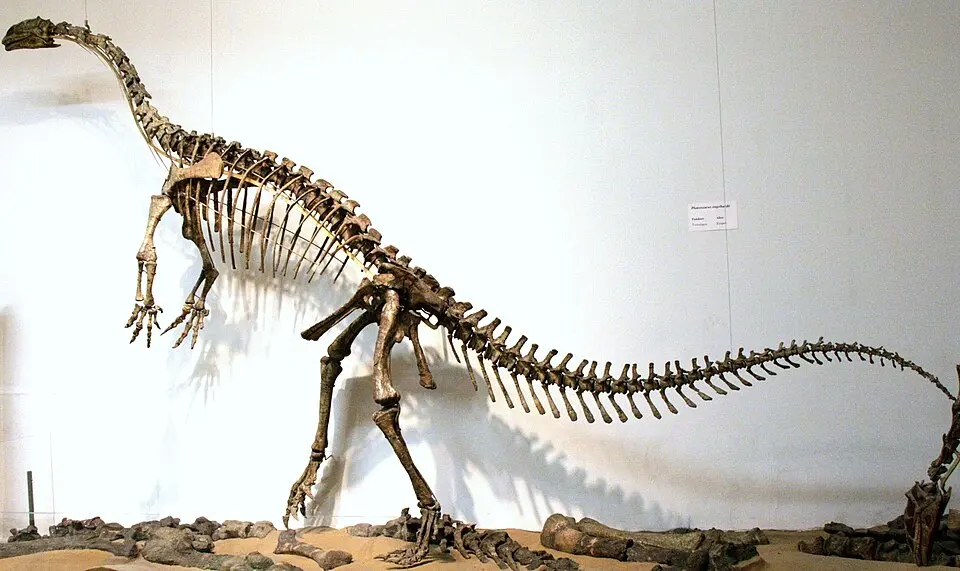
Skeleton / museum mount of Plateosaurus: Plateosaurus engelhardti skeletons "Skelett 2" on exhibit at the…
Myth or fact?
✗ Myth: Plateosaurus walked on all fours like a big lizard.
✓ Fact: Its hands could not rotate to lie flat on the ground, and its back legs were about twice as long as its arms, so it walked on two legs.
✗ Myth: Plateosaurus herds died crossing a desert, all at the same time.
✓ Fact: Most researchers now think animals got stuck one by one in muddy ground over many years, which is why so many skeletons are found standing upright in the rock.
✏️ Quick quiz
Circle the right answer. Name: ______________________
How did Plateosaurus walk?
A On four legs
B On two legs
C It slithered
D It swam
In which period did Plateosaurus live?
A Late Triassic
B Late Jurassic
C Early Cretaceous
D Late Cretaceous
In which German town have lots of Plateosaurus skeletons been found?
A Berlin
B Munich
C Hamburg
D Trossingen
Answers: 1–B 2–A 3–D
Sources and picture credits
Natural History Museum London — Plateosaurus — www.nhm.ac.uk/discover/dino-directory/plateosaurus.html
Wikipedia — Plateosaurus — en.wikipedia.org/wiki/Plateosaurus
 DinoVerse · Dinosaur fact sheet