Say it: ig-WAH-noh-don · Name means: “Iguana tooth”
Key facts about Iguanodon
⏳ Lived
126–122 million years ago Early Cretaceous
🌿 Diet
Herbivore (plant-eater)
📏 Length
9–11 m (30–36 ft)
↕️ Height
2.5–3.5 m (8–11 ft)
⚖️ Weight
3,000–5,000 kg (6,610–11,020 lb)
📍 Found in
Europe
🔎 Discovered
1822 by Gideon Mantell (and possibly Mary Ann Mantell); named 1825
About Iguanodon
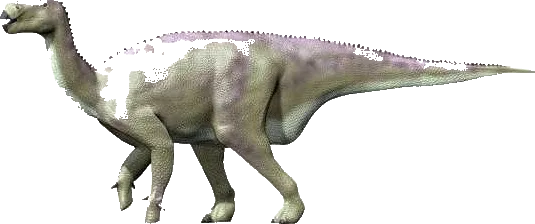
Iguanodon was a big plant-eater with a sharp spike on each thumb. It was one of the very first dinosaurs ever discovered.
Iguanodon bernissartensis was a large iguanodontian ornithopod from the Early Cretaceous of Europe, famous for its conical thumb spikes and chewing jaws. Named in 1825, it was the second dinosaur genus ever named, and changing ideas about how it looked trace the whole history of palaeontology.
Drawn to scale next to a 1.7 m adult and a 12 m school bus.
Did you know?
Iguanodon had a pointy spike on each thumb, about as long as your hand!
Its teeth looked like giant iguana teeth, which is how it got its name.
It could walk on four legs or stand up on two.
In 1878, miners in Belgium found dozens of Iguanodon skeletons deep inside a coal mine!
Iguanodon was named by Gideon Mantell in 1825, only a year after Megalosaurus, making it the second dinosaur genus ever named.
Its hand was remarkably varied: three middle fingers bore hoof-like claws for walking, the thumb was a conical spike possibly used for defence, and the fifth finger could grasp food.
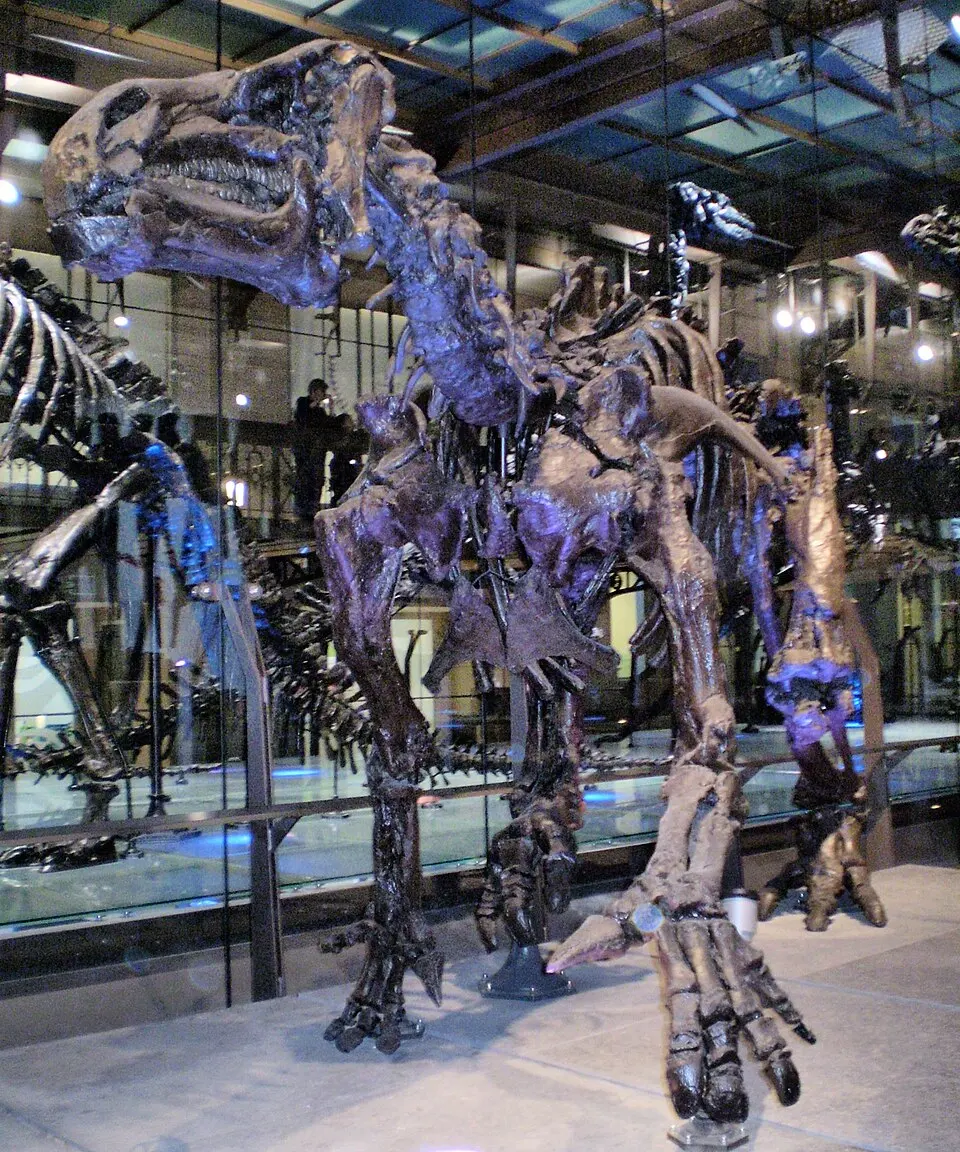
The Bernissart mine in Belgium yielded at least 38 skeletons, many complete, which Louis Dollo used to reconstruct the animal with a far more accurate shape.
Many species once placed in Iguanodon have since been moved to other genera such as Mantellisaurus, leaving I. bernissartensis as the one well-supported species.
DinoVerse· Iguanodon fact sheet
Ornithopods
🌿 What did it eat?
Food: Horsetails, Ferns, Cycads, Conifers, Early flowering plants.
Snipped plants with a toothless horny beak, then ground them up with rows of ridged cheek teeth, using a flexible upper jaw that moved sideways as it chewed.
Clues scientists use: leaf-shaped cheek teeth like a giant iguana's; tooth wear from grinding; horny beak and cheek pouches for chewing; grasping fifth finger for gathering plants.
Who might have hunted it: Neovenator, Baryonyx.
🗺️ Where fossils were found
Bernissart coal mine, Hainaut, Belgium (Europe)
Nehden, North Rhine-Westphalia, Germany (Europe)
Morella, Castellón, Spain (Europe)
Tilgate Forest, Sussex, England (first teeth) (Europe)
Photo of Iguanodon: Iguanodon de Bernissart (Iguanodon bernissartensis) présenté en position quadrupède,…
Myth or fact?
✗ Myth: Iguanodon had a horn on its nose like a rhinoceros.
✓ Fact: Gideon Mantell had only scattered bones and placed the spike on the nose. Complete skeletons from Belgium later showed it was a thumb spike.
✗ Myth: Iguanodon stood upright like a kangaroo, with its tail on the ground.
✓ Fact: Dollo's 1880s mounts stood upright, but the tail had to be broken to fit. Today scientists think it usually held its back level and often walked on all fours.
✏️ Quick quiz
Circle the right answer. Name: ______________________
Where was Iguanodon's spike really found?
A On its nose
B On its tail
C On its thumb
D On its head
What does 'Iguanodon' mean?
A Iguana tooth
B Spiky thumb
C Big lizard
D Fast runner
Where were dozens of Iguanodon skeletons found in 1878?
A On a beach
B In a desert
C Under a castle
D In a coal mine
Answers: 1–C 2–A 3–D
Sources and picture credits
Natural History Museum London — Iguanodon — www.nhm.ac.uk/discover/dino-directory/iguanodon.html
Wikipedia — Iguanodon — en.wikipedia.org/wiki/Iguanodon
 DinoVerse · Dinosaur fact sheet