Say it: YOO-oh-ploh-SEF-ah-lus · Name means: “Well-armed head”
Key facts about Euoplocephalus
⏳ Lived
76.5–75 million years ago Late Cretaceous
🌿 Diet
Herbivore (plant-eater)
📏 Length
5–6 m (16–20 ft)
↕️ Height
1.4–1.8 m (5–6 ft)
⚖️ Weight
2,000–2,500 kg (4,410–5,510 lb)
📍 Found in
North America
🔎 Discovered
1902 by Lawrence Lambe
About Euoplocephalus
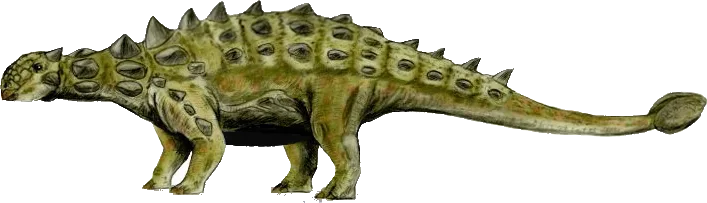
Euoplocephalus was an armoured dinosaur with a tail club and even bony eyelids. It was smaller than Ankylosaurus but built just as tough.
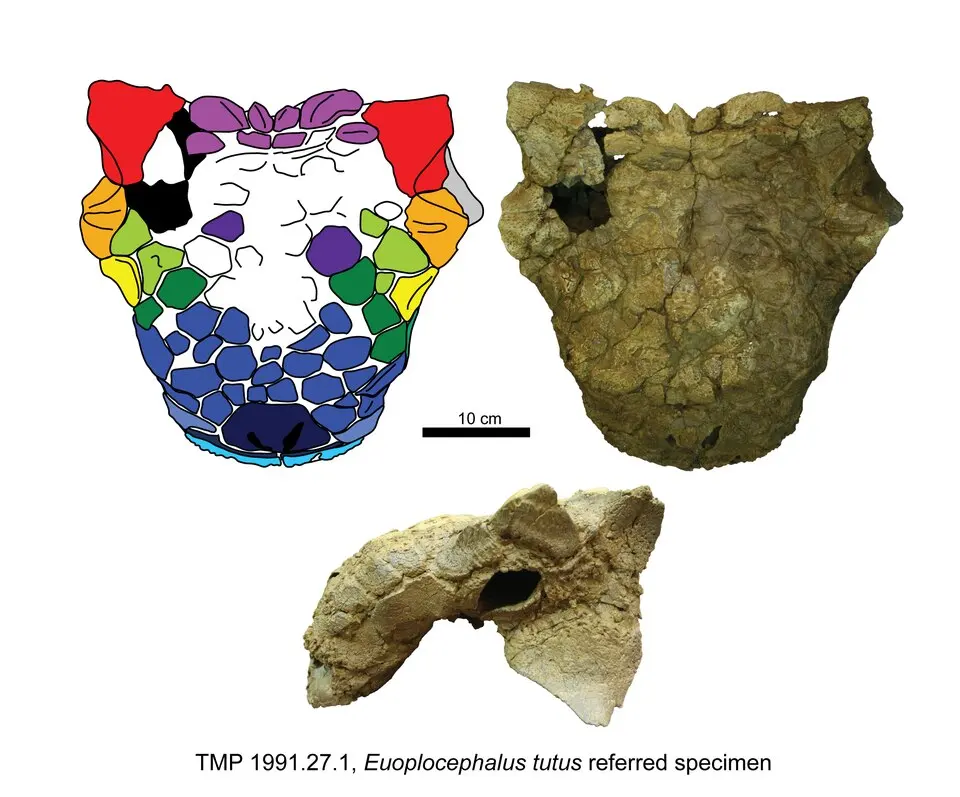
Euoplocephalus was an ankylosaurid from the Late Cretaceous Dinosaur Park Formation of Alberta. Once used as a catch-all name for many Canadian ankylosaur fossils, it is now known from a smaller set of specimens after a 2013 revision split several others into separate genera.
Drawn to scale next to a 1.7 m adult and a 12 m school bus.
Did you know?
Euoplocephalus had bony shutters over its eyes — armoured eyelids!
Its body was covered in bony bumps and spikes, like a knight in armour.
It carried a heavy club on the end of its tail.
Its nose tubes twisted around inside its head like a curly straw.
A 2013 review by Arbour and Currie reassigned many specimens once called Euoplocephalus to Anodontosaurus, Scolosaurus and Dyoplosaurus, so older books overstate how much of it we know.
CT scans of its skull show looping nasal passages that may have worked like a heat-and-water exchanger or a resonating chamber for low-frequency calls.
Its inner ear seems tuned to low-pitched sounds, which supports the idea that it communicated with deep calls.
Some researchers think Euoplocephalus could move its jaw backward during chewing, a more complex feeding style than once assumed for ankylosaurs.
 DinoVerse · Dinosaur fact sheet