Say it: ee-LAZ-moh-SORE-us · Name means: “Thin-plate lizard”
⚠️ Not a dinosaur: Elasmosaurus was a plesiosaur, a sea reptile that swam with four flippers. Dinosaurs lived on land with legs held straight under the body, and plesiosaurs belong to a completely separate branch of reptiles.
Key facts about Elasmosaurus
⏳ Lived
81–80 million years ago Late Cretaceous
🐟 Diet
Piscivore (fish-eater)
📏 Length
10–11 m (33–36 ft)
↕️ Height
0.8–1.2 m (3–4 ft)
⚖️ Weight
1,800–3,000 kg (3,970–6,610 lb)
📍 Found in
North America
🔎 Discovered
1867 by Theophilus Turner (named by Edward Drinker Cope in 1868)
About Elasmosaurus
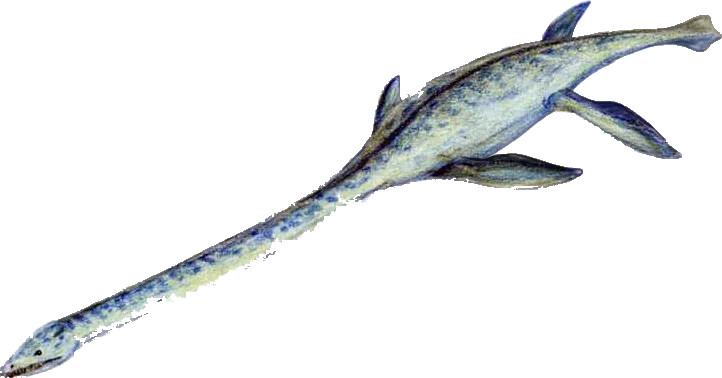
Elasmosaurus was a sea reptile with a super-long neck, a tiny head and four big flippers. It was not a dinosaur!
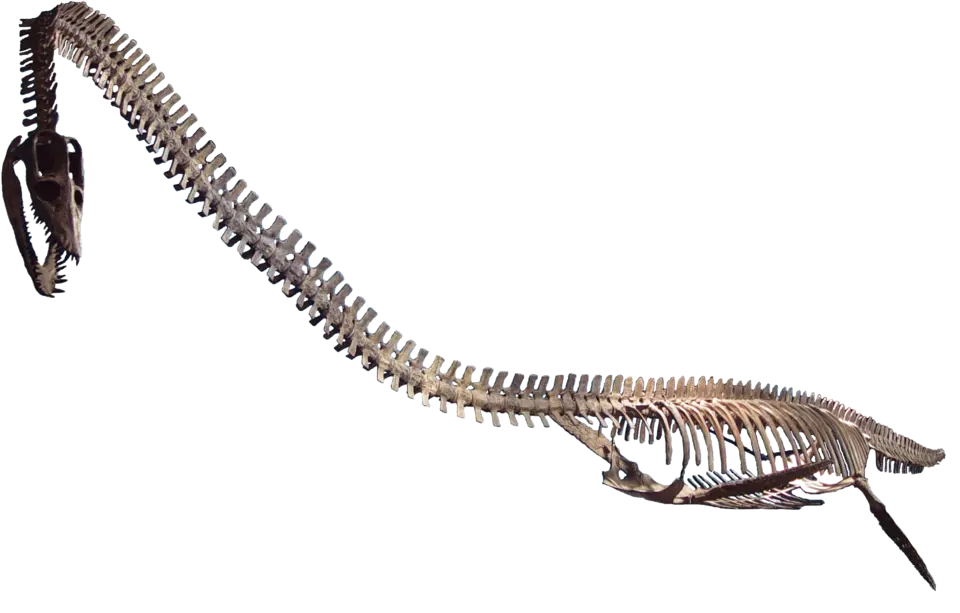
Elasmosaurus was a Late Cretaceous plesiosaur from the Western Interior Seaway, with about 72 neck vertebrae — more than any other known animal. Its neck made up more than half of its roughly 10 m length.
Drawn to scale next to a 1.7 m adult and a 12 m school bus.
Did you know?
Elasmosaurus's neck was longer than its body and tail put together!
It had about 72 bones in its neck — you have only 7.
It swam with four big flippers, like a sea turtle.
Plesiosaurs gave birth to live babies in the water instead of laying eggs.
When Edward Drinker Cope first reconstructed Elasmosaurus in 1868 he put the head on the end of the tail; his rival Othniel Marsh pointed out the error, helping start the 'Bone Wars'.
Studies of neck vertebrae suggest the neck was fairly stiff and could not be raised high out of the water like a swan's; it was probably held mostly straight and moved gently from side to side.
Related elasmosaurs have been found with stomach stones; scientists debate whether these helped grind food, controlled buoyancy, or were swallowed by accident.
A 2011 fossil of the plesiosaur Polycotylus with an embryo inside showed that plesiosaurs gave birth to a single large baby, hinting at parental care.
DinoVerse· Elasmosaurus fact sheet
Plesiosaurs
🐟 What did it eat?
Food: small fish, squid-like cephalopods, ammonites.
Probably swam slowly towards schools of fish from below, then used its small head and long, needle-like interlocking teeth to snap up fish and soft-bodied prey.
Clues scientists use: needle-like interlocking teeth; stomach contents of related elasmosaurs; gastroliths in related elasmosaurs.
Who might have hunted it: Cretoxyrhina (ginsu shark), Tylosaurus.
🗺️ Where fossils were found
Pierre Shale, Logan County, Kansas, USA (North America)
Skeleton / museum mount of Elasmosaurus: Elasmosaurus platyurus in the Rocky Mountain Dinosaur Resource…
Myth or fact?
✗ Myth: Elasmosaurus held its neck high out of the water like a swan or the 'Loch Ness monster'.
✓ Fact: Its heavy, fairly stiff neck could not lift far out of the water; it was mostly held straight out in front.
✗ Myth: Elasmosaurus was a swimming dinosaur.
✓ Fact: It was a plesiosaur, a marine reptile on a separate branch from dinosaurs.
✏️ Quick quiz
Circle the right answer. Name: ______________________
Is Elasmosaurus a dinosaur?
A Yes, a sea dinosaur
B No, it was a plesiosaur (a sea reptile)
C Yes, a long-neck sauropod
D No, it was a whale
About how many bones did Elasmosaurus have in its neck?
A 7
B 20
C 72
D 500
What mistake did Cope make with the first Elasmosaurus skeleton?
A He put the head on the tail
B He gave it wings
C He said it was a fish
D He lost the bones
Answers: 1–B 2–C 3–A
Sources and picture credits
Natural History Museum London — What is a plesiosaur? — www.nhm.ac.uk/discover/what-is-a-plesiosaur.html
Wikipedia — Elasmosaurus — en.wikipedia.org/wiki/Elasmosaurus
 DinoVerse · Dinosaur fact sheet