Say it: SEE-low-FY-sis · Name means: “Hollow form”
Key facts about Coelophysis
⏳ Lived
216–203 million years ago Late Triassic
🥩 Diet
Carnivore (meat-eater)
📏 Length
2.5–3 m (8–10 ft)
↕️ Height
0.6–1 m (2–3 ft)
⚖️ Weight
15–25 kg (30–60 lb)
📍 Found in
North America
🔎 Discovered
1881 by David Baldwin (named by Edward Drinker Cope in 1889)
About Coelophysis
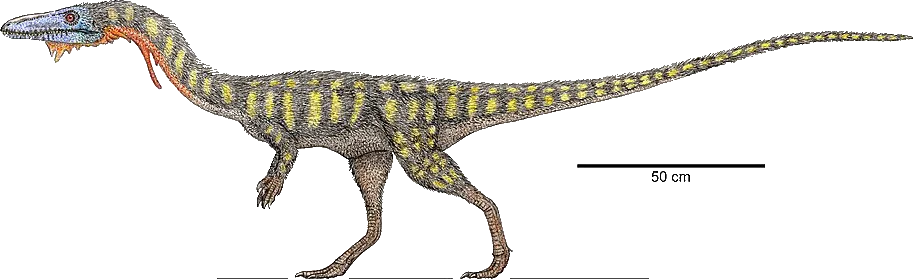
Coelophysis was one of the earliest dinosaurs, a skinny, speedy hunter about as long as a car. Hundreds of them were found together in New Mexico.
Coelophysis bauri was a slender coelophysoid theropod from the Late Triassic of the American Southwest and one of the best-known early dinosaurs. A single quarry at Ghost Ranch has produced hundreds to possibly over a thousand skeletons, giving scientists a rare look at growth and variation within one species.
Drawn to scale next to a 1.7 m adult and a 12 m school bus.
Did you know?
Coelophysis lived over 200 million years ago, near the very start of the dinosaur age.
Its bones were hollow, like a bird's, which made it light and fast.
A Coelophysis skull went into space on a Space Shuttle in 1998!
Hundreds of Coelophysis skeletons were found piled up in one spot in New Mexico.
The Ghost Ranch quarry, excavated from 1947, contains a dense mass of Coelophysis skeletons, probably animals gathered near water that died together during a drought or flood.
Adults seem to come in two body types, 'robust' and 'gracile', which was once thought to show males and females but may instead reflect normal individual variation in growth.
A Coelophysis skull from the Carnegie Museum flew aboard Space Shuttle Endeavour in 1998 to the Mir space station, making it one of the first dinosaurs in space.
It is the state fossil of New Mexico.
DinoVerse· Coelophysis fact sheet
Theropods
🥩 What did it eat?
Food: small crocodile relatives such as Hesperosuchus, lizard-like reptiles, fish, insects.
Darted after small animals on long slender legs and snapped them up with a narrow snout lined with many small, curved, serrated teeth.
Clues scientists use: small serrated teeth; remains of small crocodile-like reptiles inside Coelophysis skeletons; light, fast-running build.
Who might have hunted it: phytosaurs, Postosuchus.
🗺️ Where fossils were found
Ghost Ranch, Chinle Formation, New Mexico, USA (North America)
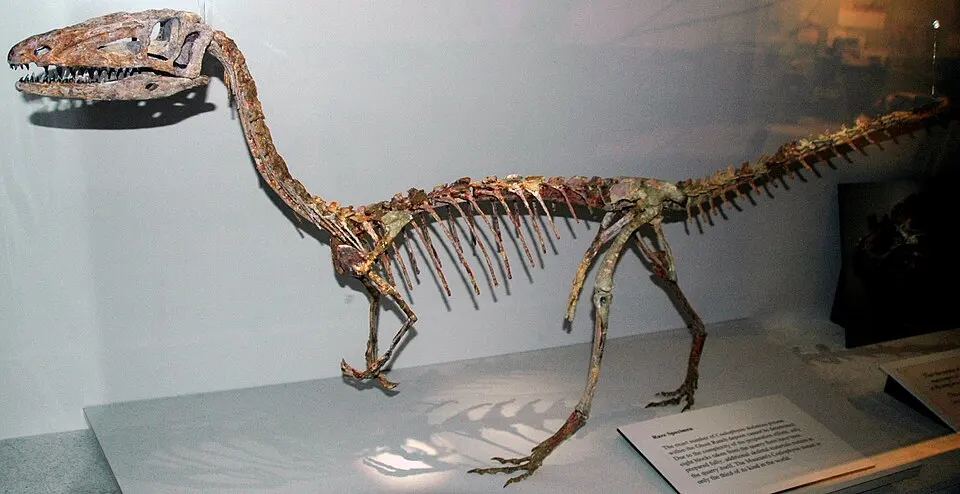
Skeleton / museum mount of Coelophysis: Coelophysis bauri (Cope, 1887) theropod dinosaur from the Triassic of…
Myth or fact?
✗ Myth: Coelophysis ate its own babies.
✓ Fact: Bones once thought to be baby Coelophysis inside adults were restudied in 2006 and turned out to be small crocodile-like reptiles, or bones lying underneath the skeleton.
✏️ Quick quiz
Circle the right answer. Name: ______________________
Which period did Coelophysis live in?
A Late Cretaceous
B Late Jurassic
C Ice Age
D Late Triassic
Where did a Coelophysis skull travel in 1998?
A Into space
B To the bottom of the ocean
C To the top of Mount Everest
D To the North Pole
What were Coelophysis's bones like?
A Solid like rocks
B Hollow like a bird's
C Made of soft cartilage
D Covered in spikes
Answers: 1–D 2–A 3–B
Sources and picture credits
Natural History Museum London — Coelophysis — www.nhm.ac.uk/discover/dino-directory/coelophysis.html
Wikipedia — Coelophysis — en.wikipedia.org/wiki/Coelophysis
 DinoVerse · Dinosaur fact sheet