Say it: tie-RAN-oh-SORE-us rex · Name means: “Tyrant lizard king”
Key facts about Tyrannosaurus rex
⏳ Lived
68–66 million years ago Late Cretaceous
🥩 Diet
Carnivore (meat-eater)
📏 Length
12–13 m (39–43 ft)
↕️ Height
3.6–4 m (12–13 ft)
⚖️ Weight
5,000–9,000 kg (11,020–19,840 lb)
📍 Found in
North America
🔎 Discovered
1902 by Barnum Brown
About Tyrannosaurus rex
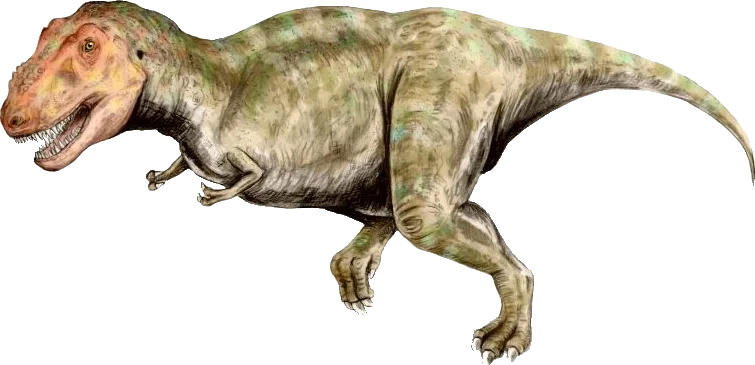
T. rex was one of the biggest meat-eaters ever to walk on land. It had a giant head, super strong jaws and tiny two-fingered arms.
Tyrannosaurus rex was a large tyrannosaurid theropod from the last two to three million years of the Cretaceous in western North America. Its forward-facing eyes, enormous olfactory bulbs and bone-crushing bite made it the apex predator of its ecosystem.
Drawn to scale next to a 1.7 m adult and a 12 m school bus.
Did you know?
A T. rex tooth could be as long as a banana!
Its arms were short, but each one could still lift about as much as a grown-up person.
T. rex could smell food from far away, because the smell part of its brain was huge.
Baby T. rex may have been covered in fluffy feathers.
Bite-force estimates for adult T. rex range from roughly 35,000 to 57,000 newtons at the back teeth, enough to puncture and crush bone.
Growth-ring studies of its bones suggest T. rex grew fastest as a teenager, adding hundreds of kilograms per year.
Fossilised skin patches from the neck, hips and tail show small scales, so adults were probably mostly scaly even though relatives like Yutyrannus had feathers.
Scientists still debate whether T. rex was mainly a hunter or a scavenger; most now think it did both, like modern lions and hyenas.
DinoVerse· Tyrannosaurus rex fact sheet
Theropods
🥩 What did it eat?
Food: Triceratops, Edmontosaurus, Ankylosaurus.
Grabbed prey with a huge mouth of thick, banana-sized serrated teeth and crushed through bone with one of the strongest bites of any land animal.
Clues scientists use: tooth shape; coprolites with bone fragments; bite marks on Triceratops and Edmontosaurus bones.
🗺️ Where fossils were found
Hell Creek Formation, Montana, USA (North America)
South Dakota, USA (North America)
Alberta, Canada (North America)
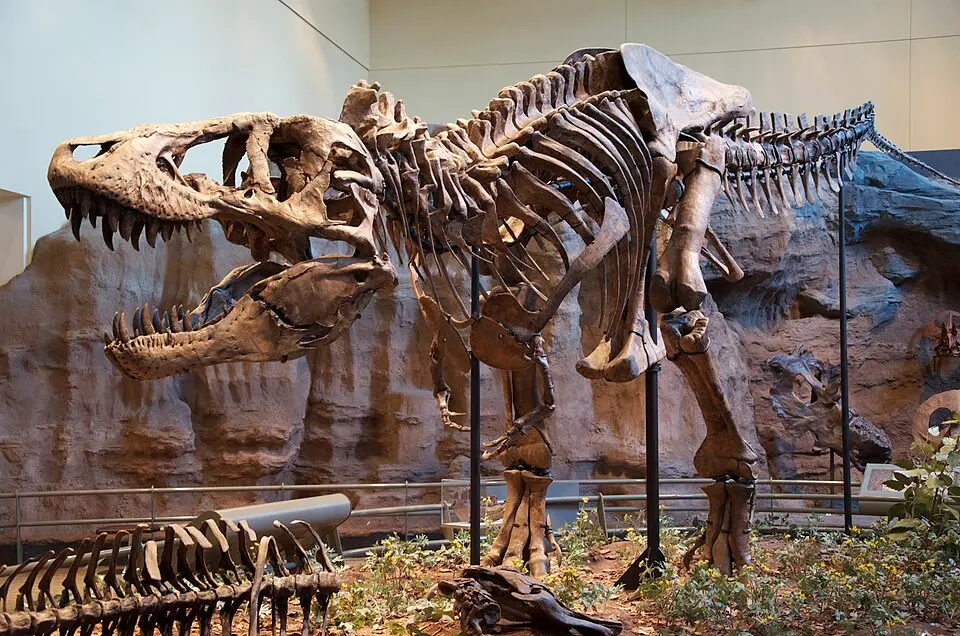
Skeleton / museum mount of Tyrannosaurus rex: Tyrannosaurus rex holotype specimen at the Carnegie Museum of…
Myth or fact?
✗ Myth: T. rex could only see you if you moved.
✓ Fact: Its forward-facing eyes gave it excellent depth perception — likely better than a hawk's.
✗ Myth: T. rex stood upright with its tail dragging on the ground.
✓ Fact: Footprints and skeletons show it held its body level, with the tail held up to balance its heavy head.
✏️ Quick quiz
Circle the right answer. Name: ______________________
What does 'Tyrannosaurus rex' mean?
A Tyrant lizard king
B Terrible claw
C Three-horned face
D Roof lizard
When did T. rex live?
A Triassic
B Early Jurassic
C Late Jurassic
D Late Cretaceous
How many fingers did each T. rex hand have?
A One
B Two
C Three
D Five
Answers: 1–A 2–D 3–B
Sources and picture credits
Natural History Museum London — Tyrannosaurus rex — www.nhm.ac.uk/discover/dino-directory/tyrannosaurus.html
Smithsonian National Museum of Natural History — The Nation's T. rex — naturalhistory.si.edu/exhibits/nations-t-rex
Wikipedia — Tyrannosaurus — en.wikipedia.org/wiki/Tyrannosaurus
Paleobiology Database — Tyrannosaurus rex — paleobiodb.org/classic/checkTaxonInfo?taxon_no=54833
Picture: Tyrannosaurus BW.jpg — Nobu Tamura (http://spinops.blogspot.com) (CC BY 2.5)
Picture: Tyrannosaurus Rex Holotype.jpg — ScottRobertAnselmo (CC BY-SA 3.0)
 DinoVerse · Dinosaur fact sheet