Say it: MOH-zah-SORE-us · Name means: “Lizard of the Meuse River”
⚠️ Not a dinosaur: Mosasaurus was a giant sea-going lizard, related to today's monitor lizards and snakes. Dinosaurs belong to a different branch of reptiles, together with crocodiles and birds.
Key facts about Mosasaurus
⏳ Lived
82–66 million years ago Late Cretaceous
🥩 Diet
Carnivore (meat-eater)
📏 Length
11–13 m (36–43 ft)
↕️ Height
1.5–2 m (5–7 ft)
⚖️ Weight
8,000–15,000 kg (17,640–33,070 lb)
📍 Found in
Europe, North America, Africa
🔎 Discovered
1764 by Quarry workers near Maastricht, Netherlands (named by William Conybeare in 1822)
About Mosasaurus
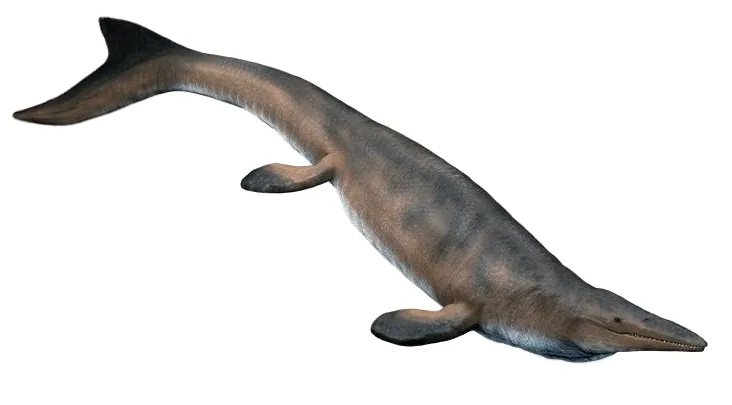
Mosasaurus was a giant sea lizard as long as a bus, with flippers and a shark-like tail. It was a top hunter of the sea but not a dinosaur!
Mosasaurus was one of the largest mosasaurs, a group of marine squamates that ruled Late Cretaceous seas until the end-Cretaceous extinction. Its type species, M. hoffmannii, reached about 11–13 m, while other species such as M. missouriensis were smaller.
Drawn to scale next to a 1.7 m adult and a 12 m school bus.
Did you know?
Mosasaurus was about as long as a school bus!
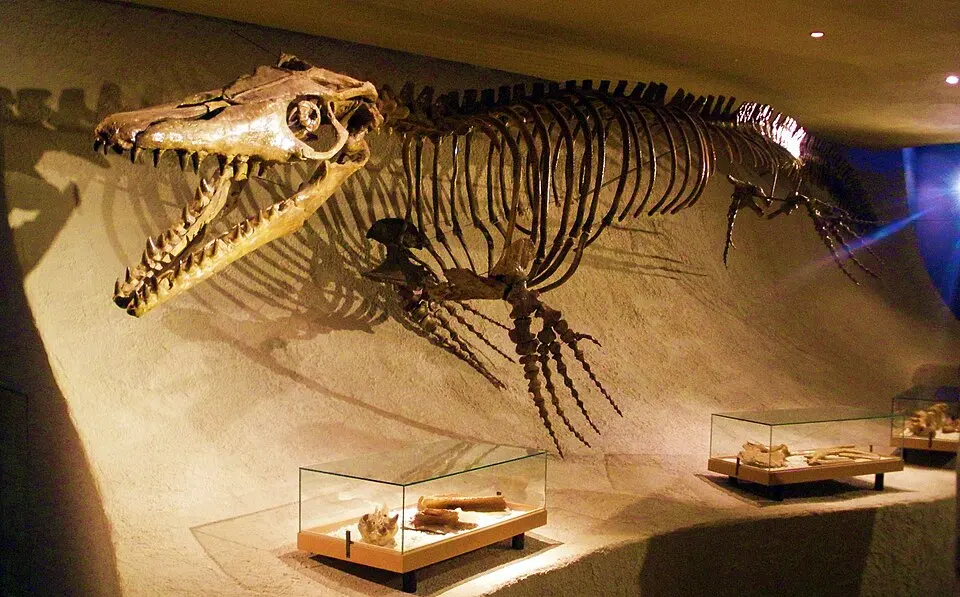
It had an extra row of teeth on the roof of its mouth to help it swallow.
The first Mosasaurus skull was found in the Netherlands more than 250 years ago.
It was a giant cousin of today's monitor lizards and snakes.
A well-preserved specimen of the related mosasaur Prognathodon showed that mosasaurs had a downward-bent tail ending in a shark-like fluke, changing how artists draw them.
Embryos found inside related mosasaurs show that mosasaurs gave birth to live young at sea instead of laying eggs on land.
Holes in some ammonite shells were once blamed on mosasaur bites; some are convincing, but others may have been made by limpets, so researchers treat each case carefully.
Whether mosasaurs are closer to monitor lizards or to snakes is still debated, but all studies agree they are squamates (scaly reptiles), not dinosaurs.
The famous Maastricht skull was taken to Paris by French troops in 1794 and is still there today.
Chased or ambushed prey with powerful sweeps of its finned tail, seized it with thick, cone-shaped teeth, and used an extra row of teeth on the roof of its mouth to pull food down its throat.
Clues scientists use: tooth shape and wear; stomach contents of related mosasaurs; bite marks on turtle shells and other mosasaurs.
 DinoVerse · Dinosaur fact sheet