Say it: LY-oh-PLOOR-oh-don · Name means: “Smooth-sided teeth”
⚠️ Not a dinosaur: Liopleurodon was a pliosaur, a short-necked kind of plesiosaur that lived in the sea. Dinosaurs were land animals with legs held straight under the body, and plesiosaurs are a separate branch of reptiles.
Key facts about Liopleurodon
⏳ Lived
166–162 million years ago Middle Jurassic
🥩 Diet
Carnivore (meat-eater)
📏 Length
5–7 m (16–23 ft)
↕️ Height
1–1.5 m (3–5 ft)
⚖️ Weight
1,000–1,700 kg (2,200–3,750 lb)
📍 Found in
Europe
🔎 Discovered
1873 by Henri-Émile Sauvage
About Liopleurodon
Liopleurodon was a big sea reptile with a huge head, strong jaws and four flippers. It was a top hunter in Jurassic seas, but it was not a dinosaur!
Liopleurodon was a pliosaurid from the Middle Jurassic (Callovian) seas of Europe and a top predator of its time. Well-studied specimens from the Oxford Clay suggest adults typically reached about 5–7 m, with a skull over a metre long.
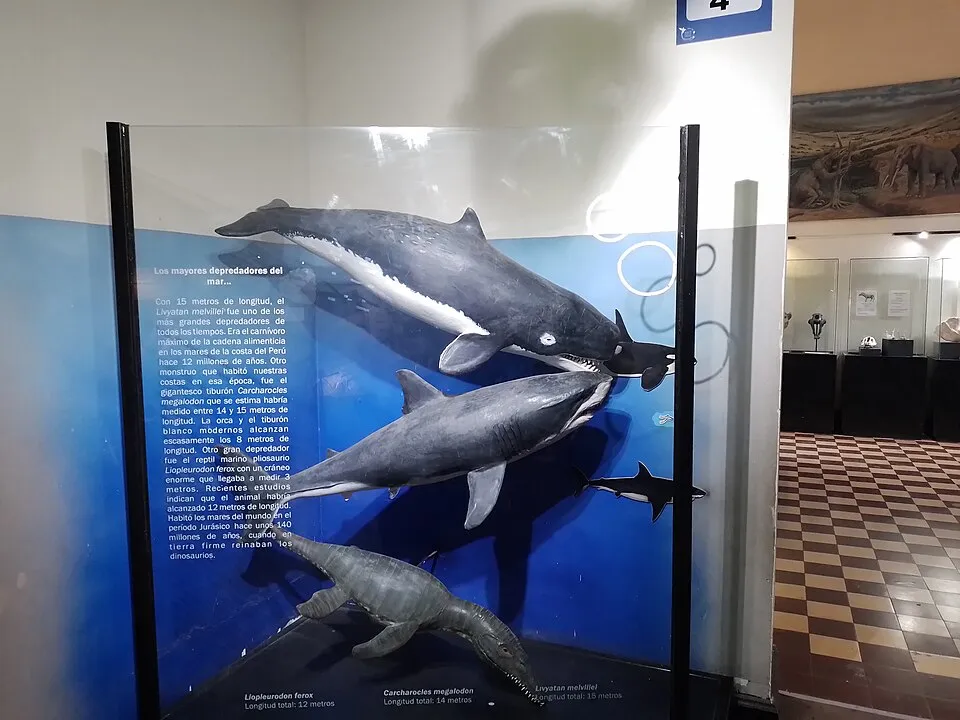
Drawn to scale next to a 1.7 m adult and a 12 m school bus.
Did you know?
Liopleurodon's head was more than a metre long — longer than a baseball bat!
It swam with four flippers, flapping them like underwater wings.
It probably ate fish, squid and even other sea reptiles.
TV once said it was 25 metres long, but scientists now think it was about the size of a killer whale or smaller.
Size estimates of 15–25 m once popularised on television came from scaling up isolated or misidentified bones; specimens of L. ferox suggest a typical length of around 6 m.
Its internal nostrils sat in front of its external ones; one hypothesis is that water flowed through them so it could 'smell' underwater in stereo, but this idea is still debated.
Studies of four-flipper swimming suggest pliosaurs used their flippers for powerful bursts rather than long-distance cruising, fitting an ambush-hunting lifestyle.
Bones of other marine reptiles from the Oxford Clay show bite marks consistent with large pliosaurs like Liopleurodon.
Ambushed large prey with a burst of speed from its four powerful flippers, gripping with long, cone-shaped teeth at the front of its huge jaws and tearing chunks off.
Clues scientists use: large cone-shaped teeth; powerful jaw muscle attachments; bite marks on bones of marine reptiles.
🗺️ Where fossils were found
Oxford Clay, Peterborough, England (Europe)
Boulogne-sur-Mer, France (Europe)
Northern Germany (Europe)
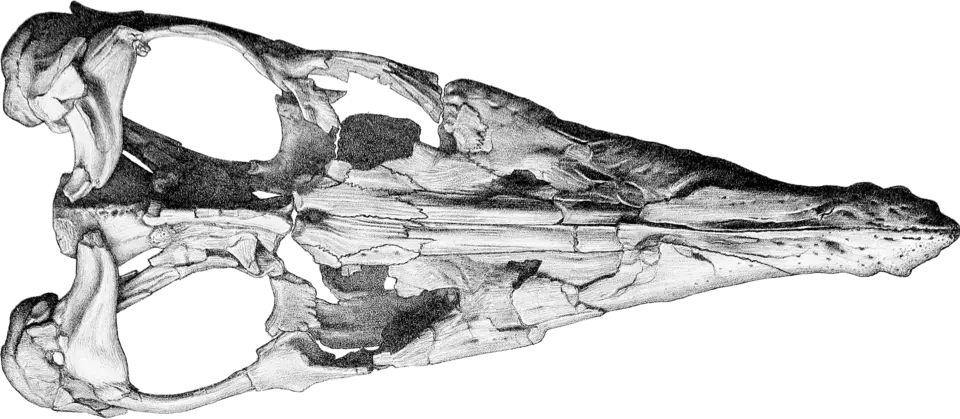
Skull of Liopleurodon: Illustration of the skull of Liopleurodon ferox in dorsal view from A descriptive…
Myth or fact?
✗ Myth: Liopleurodon was 25 metres long — the biggest predator ever.
✓ Fact: That figure was exaggerated on TV; most scientists estimate adults at about 5–7 m long.
✗ Myth: Liopleurodon was a sea dinosaur.
✓ Fact: It was a pliosaur, a kind of plesiosaur — a marine reptile, not a dinosaur.
✏️ Quick quiz
Circle the right answer. Name: ______________________
Is Liopleurodon a dinosaur?
A Yes, a swimming dinosaur
B Yes, a giant fish dinosaur
C No, it was a shark
D No, it was a pliosaur (sea reptile)
How did Liopleurodon swim?
A With four flippers
B With a fish-like tail only
C By walking on the seafloor
D With wings
About how long was Liopleurodon really?
A 1 metre
B 25 metres
C 5–7 metres
D 50 metres
Answers: 1–D 2–A 3–C
Sources and picture credits
Natural History Museum London — What is a plesiosaur? — www.nhm.ac.uk/discover/what-is-a-plesiosaur.html
Wikipedia — Liopleurodon — en.wikipedia.org/wiki/Liopleurodon
Picture: Ejemplares de un Liopleurodon ferox, un Carcharocles megalodon y un Livyatan melvillei de abajo hacia arriba respectivamente.jpg — Suki3464 (CC BY-SA 4.0)
Picture: Liopleurodon Skull Dorsal View - Extracted.png — G. M. Woodward, in publication by Charles William Andrews (Public domain)
 DinoVerse · Dinosaur fact sheet