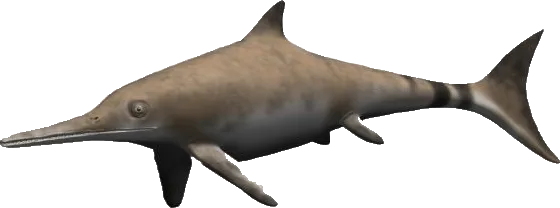
Say it: IK-thee-oh-SORE-us · Name means: “Fish lizard”
⚠️ Not a dinosaur: Ichthyosaurus was an ichthyosaur, a dolphin-shaped reptile that spent its whole life in the sea. Dinosaurs were land animals with legs held straight under the body, and ichthyosaurs evolved on a separate branch of reptiles.
Key facts about Ichthyosaurus
⏳ Lived
200–190 million years ago Early Jurassic
🐟 Diet
Piscivore (fish-eater)
📏 Length
1.5–3.3 m (5–11 ft)
↕️ Height
0.4–0.6 m (1–2 ft)
⚖️ Weight
50–200 kg (110–440 lb)
📍 Found in
Europe
🔎 Discovered
1811 by Joseph and Mary Anning
About Ichthyosaurus
Ichthyosaurus was a sea reptile shaped like a dolphin, with huge eyes and a long, pointy snout. It was not a dinosaur!
Ichthyosaurus was a mid-sized ichthyosaur from the Early Jurassic seas of southwest England and nearby Europe. Fossils found by Mary Anning and her family helped prove that whole groups of animals had gone extinct.
Drawn to scale next to a 1.7 m adult and a 12 m school bus.
Did you know?
Ichthyosaurus looked a lot like a dolphin, but it was a reptile!
It had giant eyes to help it see in dark, deep water.
Ichthyosaurus mums gave birth to babies in the water — they didn't lay eggs.
A girl called Mary Anning and her brother found one of the first Ichthyosaurus fossils over 200 years ago.
Ichthyosaurs and dolphins evolved similar streamlined bodies, fins and tail flukes independently — a textbook example of convergent evolution.
Fossil mothers with embryos inside, including some with babies emerging tail-first, show that ichthyosaurs gave birth to live young at sea, as dolphins do.
Studies of preserved skin from related ichthyosaurs found dark melanin pigment and a fatty layer like blubber, suggesting they were warm-bodied and darkly coloured.
In 2015 a new species, Ichthyosaurus anningae, was named in honour of Mary Anning, whose discoveries helped launch the science of palaeontology.
DinoVerse· Ichthyosaurus fact sheet
Ichthyosaurs
🐟 What did it eat?
Food: small fish, belemnites, squid-like cephalopods.
Chased fast prey through the water and grabbed it with a long, narrow snout full of small, sharp, cone-shaped teeth, swallowing it whole.
Clues scientists use: belemnite hooks and fish scales in the stomach area; coprolites; small cone-shaped teeth.
Who might have hunted it: Temnodontosaurus, large plesiosaurs.
🗺️ Where fossils were found
Lyme Regis, Dorset, England (Europe)
Street, Somerset, England (Europe)
Watchet, Somerset, England (Europe)
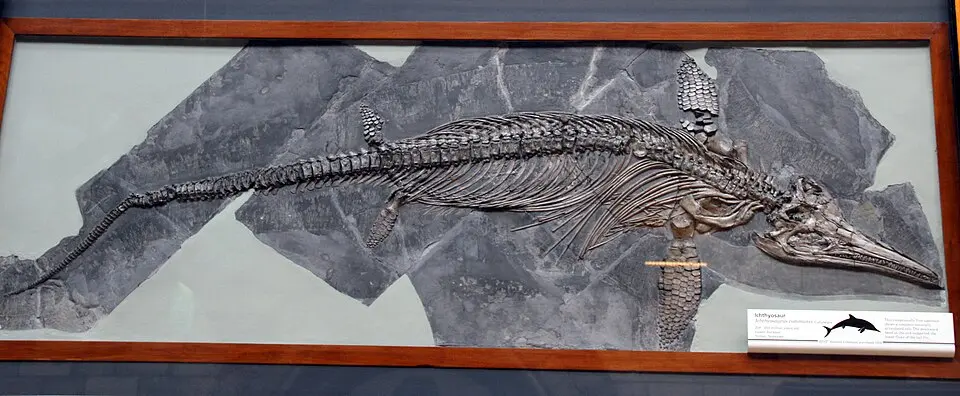
Skeleton / museum mount of Ichthyosaurus: Natural History Museum, London, England, UK. Complete indexed photo…
Myth or fact?
✗ Myth: Ichthyosaurus was a kind of dinosaur, or a giant fish.
✓ Fact: It was neither — it was an ichthyosaur, a sea reptile that breathed air, on its own branch of the reptile family tree.
✗ Myth: Mary Anning found the very first ichthyosaur bones ever.
✓ Fact: Odd bones had been found before, but the Annings' specimens were the first good skulls and skeletons that helped scientists recognise ichthyosaurs as a new kind of animal.
✏️ Quick quiz
Circle the right answer. Name: ______________________
Is Ichthyosaurus a dinosaur?
A Yes, a swimming dinosaur
B No, it was a fish
C No, it was a sea reptile called an ichthyosaur
D Yes, a type of dolphin dinosaur
What does 'Ichthyosaurus' mean?
A Fish lizard
B Sea dragon
C Dolphin tooth
D Smooth-sided teeth
Who found some of the first Ichthyosaurus fossils?
A Barnum Brown
B Charles Darwin
C Edward Drinker Cope
D Mary Anning and her brother Joseph
Answers: 1–C 2–A 3–D
Sources and picture credits
Natural History Museum London — Mary Anning: the unsung hero of fossil discovery — www.nhm.ac.uk/discover/mary-anning-unsung-hero.html
Wikipedia — Ichthyosaurus — en.wikipedia.org/wiki/Ichthyosaurus
 DinoVerse · Dinosaur fact sheet