Say it: koh-RITH-oh-SORE-us · Name means: “Helmet lizard”
Key facts about Corythosaurus
⏳ Lived
77–75.7 million years ago Late Cretaceous
🌿 Diet
Herbivore (plant-eater)
📏 Length
7.7–9 m (25–30 ft)
↕️ Height
2.5–3 m (8–10 ft)
⚖️ Weight
2,800–4,000 kg (6,170–8,820 lb)
📍 Found in
North America
🔎 Discovered
1911 by Barnum Brown
About Corythosaurus
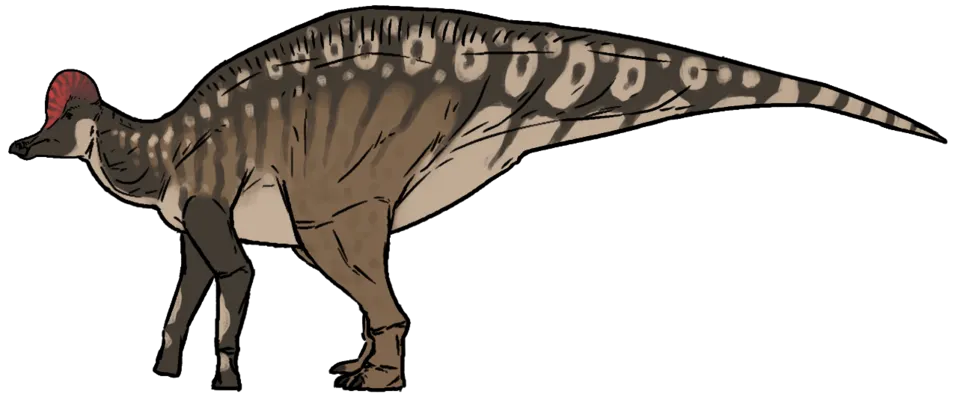
Corythosaurus was a duck-billed dinosaur with a round crest on its head shaped like half a dinner plate. The crest was hollow and may have helped it make loud calls.
Corythosaurus casuarius was a lambeosaurine hadrosaurid from the Late Campanian of Alberta, known from many complete skeletons, some with skin impressions. Its helmet-like crest enclosed looping nasal passages that may have acted as a resonating chamber for calls.
Drawn to scale next to a 1.7 m adult and a 12 m school bus.
Did you know?
Corythosaurus had a tall, round crest that looked like a helmet!
Its crest was hollow inside, so it may have honked like a giant trumpet.
Some of its fossils even show the bumpy pattern of its skin.
Some Corythosaurus fossils sank to the bottom of the ocean when the ship carrying them was sunk in 1916!
CT scans of lambeosaurine skulls, including Corythosaurus, show inner ears suited to low-frequency hearing and enlarged brain regions possibly linked to social behaviour, supporting the idea that crests were used for calling and display.
In the 1970s Peter Dodson showed that several 'species' of crested hadrosaurs in Alberta were really juveniles, females and males of the same animals at different growth stages.
Two specimens collected by the Sternberg family were lost in 1916 when the SS Mount Temple, carrying them to the British Museum, was sunk by a German raider during World War I.
Its crest grew as it aged: juveniles had only a small bump, and the full helmet shape appeared as animals approached adult size.
DinoVerse· Corythosaurus fact sheet
Ornithopods
🌿 What did it eat?
Food: Conifer needles and twigs, Seeds and fruits, Flowering shrubs, Ferns.
Plucked leaves, twigs and fruit with a narrow beak, then ground them with dental batteries of hundreds of tightly packed cheek teeth.
Clues scientists use: dental batteries with grinding surfaces; narrow beak suited to selective feeding; tooth wear; gut contents and coprolites from related hadrosaurs.
Who might have hunted it: Gorgosaurus, Daspletosaurus.
🗺️ Where fossils were found
Dinosaur Provincial Park, Red Deer River, Alberta, Canada (North America)
Oldman Formation, Alberta, Canada (North America)
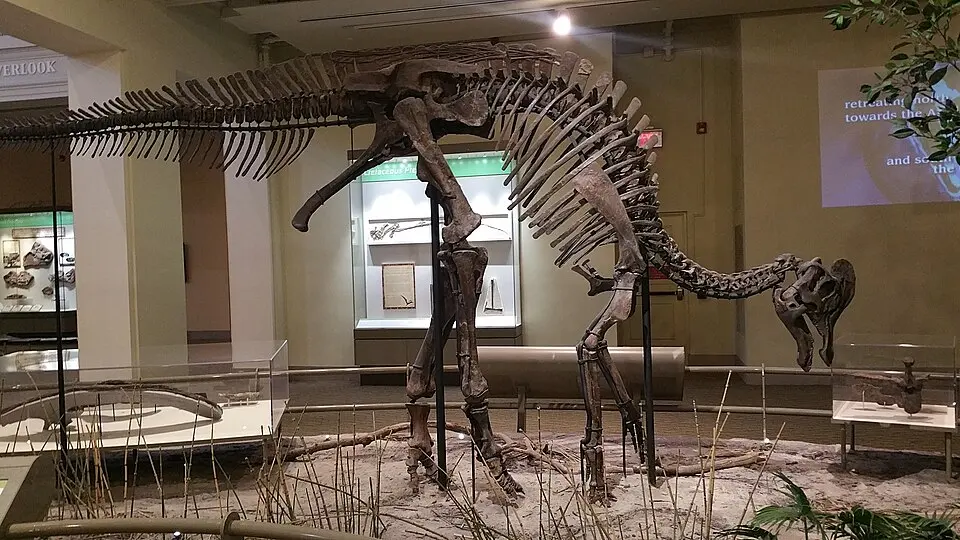
Skeleton / museum mount of Corythosaurus: The "Dinosaurs in Their Time" exhibit at the Carnegie Museum of…
Myth or fact?
✗ Myth: Corythosaurus used its crest like a snorkel or air tank to stay underwater.
✓ Fact: The crest had no opening at the top and held only a small amount of air, so it could not work as a snorkel. Corythosaurus lived and fed on land.
✗ Myth: Every different crest shape was a different species.
✓ Fact: Crests changed shape as hadrosaurs grew and may have differed between males and females, so many old 'species' turned out to be the same animal.
✏️ Quick quiz
Circle the right answer. Name: ______________________
What does 'Corythosaurus' mean?
A Crested duck
B Helmet lizard
C Trumpet lizard
D Round head
What happened to some Corythosaurus fossils in 1916?
A They were sunk with a ship
B They were stolen by pirates
C They were sent to the Moon
D They melted
Which predator might have hunted Corythosaurus?
A Velociraptor
B Spinosaurus
C Allosaurus
D Gorgosaurus
Answers: 1–B 2–A 3–D
Sources and picture credits
Natural History Museum London — Corythosaurus — www.nhm.ac.uk/discover/dino-directory/corythosaurus.html
Wikipedia — Corythosaurus — en.wikipedia.org/wiki/Corythosaurus
 DinoVerse · Dinosaur fact sheet