Say it: BRAK-ee-oh-SORE-us · Name means: “Arm lizard”
Key facts about Brachiosaurus
⏳ Lived
155–145 million years ago Late Jurassic
🌿 Diet
Herbivore (plant-eater)
📏 Length
18–22 m (59–72 ft)
↕️ Height
9–13 m (30–43 ft)
⚖️ Weight
28,000–58,000 kg (61,730–127,870 lb)
📍 Found in
North America
🔎 Discovered
1900 by Elmer S. Riggs
About Brachiosaurus
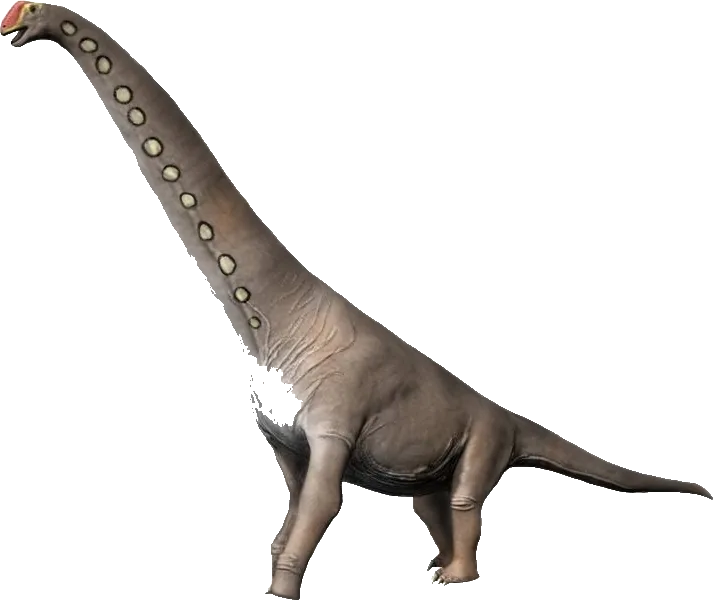
Brachiosaurus was a gigantic plant-eater with front legs longer than its back legs. It held its neck up high like a giraffe to munch on treetops.
Brachiosaurus altithorax was a brachiosaurid sauropod from the Late Jurassic Morrison Formation of western North America. Its long forelimbs and steeply sloping back let it browse higher than almost any other animal of its time, and it is known from fewer bones than many famous mounts suggest.
Drawn to scale next to a 1.7 m adult and a 12 m school bus.
Did you know?
Brachiosaurus could peek into a window on the fourth floor of a building!
Its front legs were longer than its back legs, so its back sloped down like a slide.
It may have eaten hundreds of kilograms of leaves every single day.
Many of its bones were full of air pockets, which made its huge body a bit lighter.
The type specimen was found by Elmer Riggs's Field Museum team near Grand Junction, Colorado in 1900 and named in 1903; it remains one of the most complete Brachiosaurus skeletons, yet it lacks a skull.
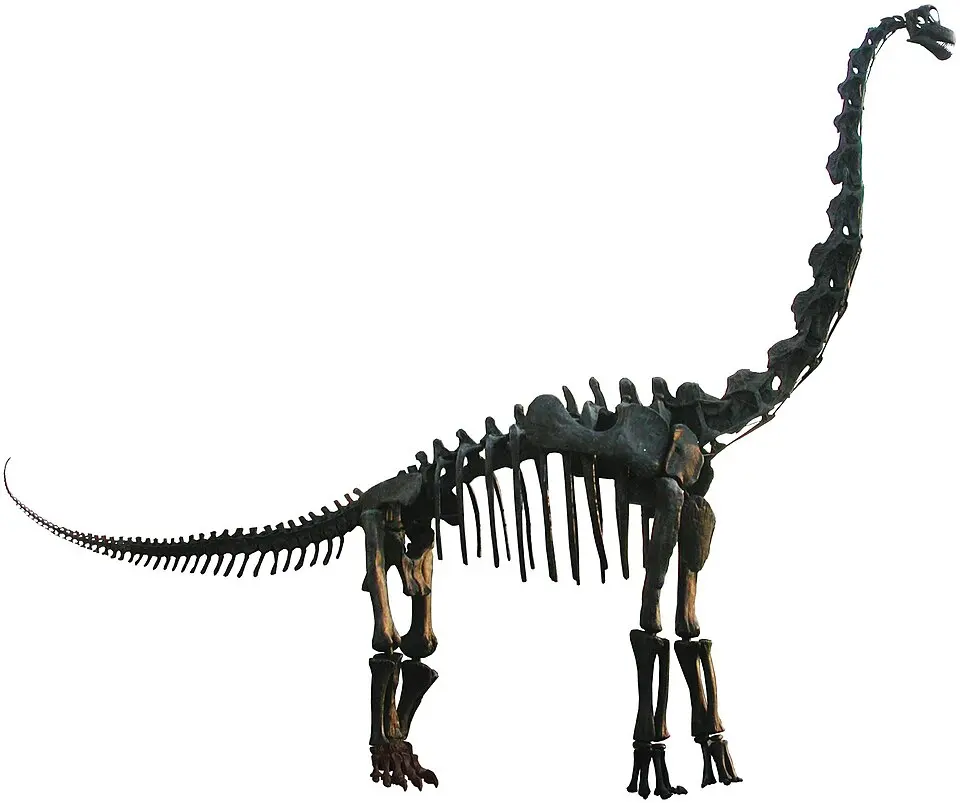
The famous mounted skeleton in Berlin belongs to Giraffatitan brancai from Tanzania, which was moved out of Brachiosaurus into its own genus in 2009 after detailed comparisons of the vertebrae.
Mass estimates vary widely, from under 30 tonnes to over 55 tonnes, because the skeleton is incomplete and scientists use different methods, such as limb-bone scaling or 3D volume models.
Researchers still debate how vertically it held its neck; the neck joints and tall shoulders suggest a raised posture, but blood pressure needed to pump blood to a head 12 m up would have been enormous.
DinoVerse· Brachiosaurus fact sheet
Sauropods
🌿 What did it eat?
Food: Conifer leaves (such as monkey-puzzle relatives), Ginkgo leaves, Cycads, Tree ferns.
Reached high into the treetops with its upright neck and stripped leaves using broad, chisel-shaped teeth, then swallowed them whole without chewing; its huge gut did the rest of the work.
Clues scientists use: broad chisel-shaped tooth shape; tooth wear patterns; very tall shoulders and upward-angled neck suited to high browsing; plant fossils from the Morrison Formation.
Who might have hunted it: Allosaurus, Torvosaurus, Ceratosaurus.
🗺️ Where fossils were found
Riggs Hill, near Grand Junction, Colorado, USA (North America)
Dry Mesa Quarry, Colorado, USA (North America)
Morrison Formation, Wyoming, USA (North America)
Skeleton / museum mount of Brachiosaurus: The mounted skeleton of Brachiosaurus altithorax outside the Field…
Myth or fact?
✗ Myth: Brachiosaurus lived in lakes and swamps because it was too heavy to stand on land.
✓ Fact: Its pillar-like legs, compact feet and air-filled bones show it was fully built for life on land. Underwater, water pressure would have made breathing very difficult.
✗ Myth: The nostrils on top of its head worked like a snorkel.
✓ Fact: The bony nostril openings were high on the skull, but studies of the soft tissues suggest the fleshy nostrils sat lower, near the front of the snout.
✏️ Quick quiz
Circle the right answer. Name: ______________________
What does the name 'Brachiosaurus' mean?
A Long-neck lizard
B Arm lizard
C Thunder lizard
D Giant lizard
Which legs of Brachiosaurus were longer?
A The back legs
B They were all the same
C The front legs
D It had no front legs
Where did Brachiosaurus get most of its food?
A From the ocean
B From other dinosaurs
C From underground roots
D From tall trees
Answers: 1–B 2–C 3–D
Sources and picture credits
Natural History Museum London — Brachiosaurus — www.nhm.ac.uk/discover/dino-directory/brachiosaurus.html
Wikipedia — Brachiosaurus — en.wikipedia.org/wiki/Brachiosaurus
 DinoVerse · Dinosaur fact sheet