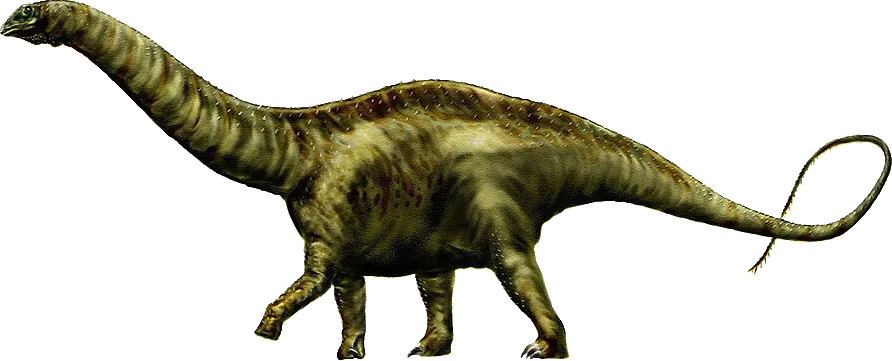
Say it: ah-PAT-oh-SORE-us · Name means: “Deceptive lizard”
Key facts about Apatosaurus
⏳ Lived
152–151 million years ago Late Jurassic
🌿 Diet
Herbivore (plant-eater)
📏 Length
21–23 m (69–75 ft)
↕️ Height
4.5–5 m (15–16 ft)
⚖️ Weight
16,000–33,000 kg (35,270–72,750 lb)
📍 Found in
North America
🔎 Discovered
1877 by Othniel Charles Marsh
About Apatosaurus
Apatosaurus was a huge long-necked plant-eater with a super thick neck and a whip-like tail. It was a very close cousin of Brontosaurus.
Apatosaurus was a heavily built diplodocid sauropod from the Late Jurassic Morrison Formation of the western United States. It had unusually broad, deep neck vertebrae, which some scientists think point to neck-to-neck combat, and its tangled naming history with Brontosaurus is one of the most famous stories in palaeontology.
Drawn to scale next to a 1.7 m adult and a 12 m school bus.
Did you know?
Apatosaurus weighed about as much as four or five elephants!
Its neck was so thick and chunky that it was wider than its body in some places.
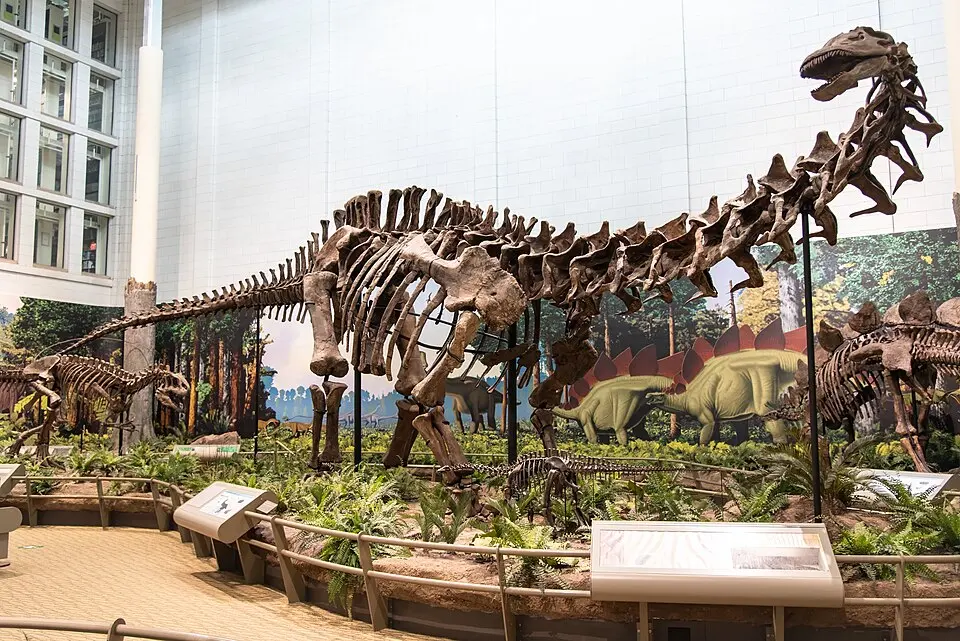
For many years, museum skeletons of Apatosaurus wore the wrong head!
Its tail was long and skinny at the end, like a whip.
Its neck vertebrae have huge, low-hanging cervical ribs, making the neck triangular in cross-section; one hypothesis is that males fought by shoving or striking with their necks.
For decades museum mounts carried a short, boxy Camarasaurus-like skull; in the 1970s John McIntosh and David Berman showed that a longer, Diplodocus-like skull belonged to Apatosaurus, and the Carnegie Museum mounted the correct head in 1979.
A 1999 bone-microstructure study concluded that Apatosaurus grew very rapidly when young and reached near-adult size in about 10 years.
Mass estimates vary from about 16 to over 30 tonnes depending on the species, the specimen and the method used.
Swung its thick, powerful neck from side to side to crop low and mid-height plants with simple peg-like teeth, swallowing them whole to be broken down in its huge gut.
Clues scientists use: peg-like tooth shape; tooth wear; square, broad snout suited to cropping; plant fossils from the Morrison Formation.
Who might have hunted it: Allosaurus, Torvosaurus, Ceratosaurus.
🗺️ Where fossils were found
Morrison, Colorado, USA (North America)
Como Bluff, Wyoming, USA (North America)
Dinosaur National Monument, Utah, USA (North America)
Kenton, Oklahoma, USA (North America)
Skeleton / museum mount of Apatosaurus: Apatosaurus louisae (CM 3018) mounted fossil skeleton on display at…
Myth or fact?
✗ Myth: Apatosaurus and Brontosaurus are just two names for the same dinosaur.
✓ Fact: O. C. Marsh named Apatosaurus in 1877 and Brontosaurus in 1879. In 1903 Elmer Riggs decided they were the same, and the older name Apatosaurus won. But a big 2015 study found enough differences to bring Brontosaurus back as its own genus, so today they are close cousins, not one animal.
✗ Myth: Sauropods like Apatosaurus lived in swamps to support their weight.
✓ Fact: Its strong, column-like legs, footprints on dry ground and air-filled bones show it was a land animal.
✗ Myth: Apatosaurus dragged its tail on the ground.
✓ Fact: Trackways almost never show tail drag marks; the tail was held up to balance the long neck.
✏️ Quick quiz
Circle the right answer. Name: ______________________
What does 'Apatosaurus' mean?
A Thunder lizard
B Heavy lizard
C Arm lizard
D Deceptive lizard
In what year was Brontosaurus brought back as its own genus?
A 1903
B 2015
C 1879
D 1979
What mistake did museums make with Apatosaurus for many years?
A They gave it the wrong head
B They put it upside down
C They gave it wings
D They made it too small
Answers: 1–D 2–B 3–A
Sources and picture credits
Natural History Museum London — Apatosaurus — www.nhm.ac.uk/discover/dino-directory/apatosaurus.html
Wikipedia — Apatosaurus — en.wikipedia.org/wiki/Apatosaurus
Wikipedia — Brontosaurus — en.wikipedia.org/wiki/Brontosaurus
 DinoVerse · Dinosaur fact sheet