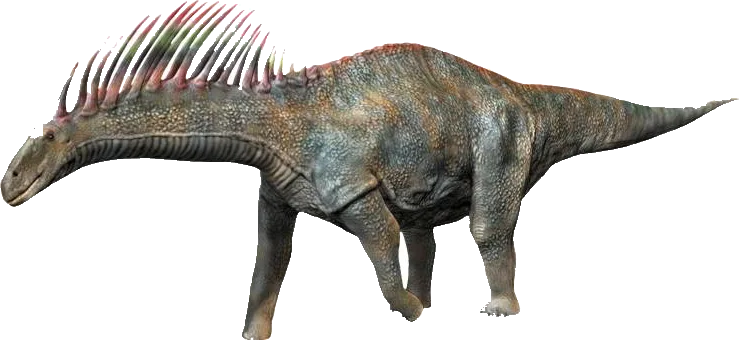
Say it: ah-MAR-gah-SORE-us · Name means: “La Amarga lizard”
Key facts about Amargasaurus
⏳ Lived
129–122 million years ago Early Cretaceous
🌿 Diet
Herbivore (plant-eater)
📏 Length
9–10 m (30–33 ft)
↕️ Height
2.4–3 m (8–10 ft)
⚖️ Weight
2,600–4,000 kg (5,730–8,820 lb)
📍 Found in
South America
🔎 Discovered
1984 by Expedition led by José Bonaparte (named by Leonardo Salgado and José Bonaparte, 1991)
About Amargasaurus
Amargasaurus was a small long-necked dinosaur with two rows of tall spikes running down its neck and back. It lived in what is now Argentina.
Amargasaurus cazaui was a dicraeosaurid sauropod from the Early Cretaceous of Patagonia, notable for two parallel rows of very long neural spines on its neck. What these spines looked like in life, and what they were for, is still debated.
Drawn to scale next to a 1.7 m adult and a 12 m school bus.
Did you know?
Amargasaurus had two rows of spikes on its neck, some longer than your arm!
Compared with other long-necked dinosaurs, it was quite small, about as long as a bus.
Its name comes from La Amarga, the canyon in Argentina where it was found.
It probably ate low plants, like ferns, close to the ground.
The longest neck spines reached about 60 cm and were paired, leaving only a few centimetres between the two rows, which makes the old idea of two separate skin sails unlikely.
Hypotheses for the spines include display to rivals or mates, defence, or a single skin sail; a 2022 bone-structure study by Cerda and colleagues argued against the popular idea of a long horny sheath on each spine.
It belongs to Dicraeosauridae, a family of relatively short-necked sauropods related to Diplodocus that likely fed low to the ground.
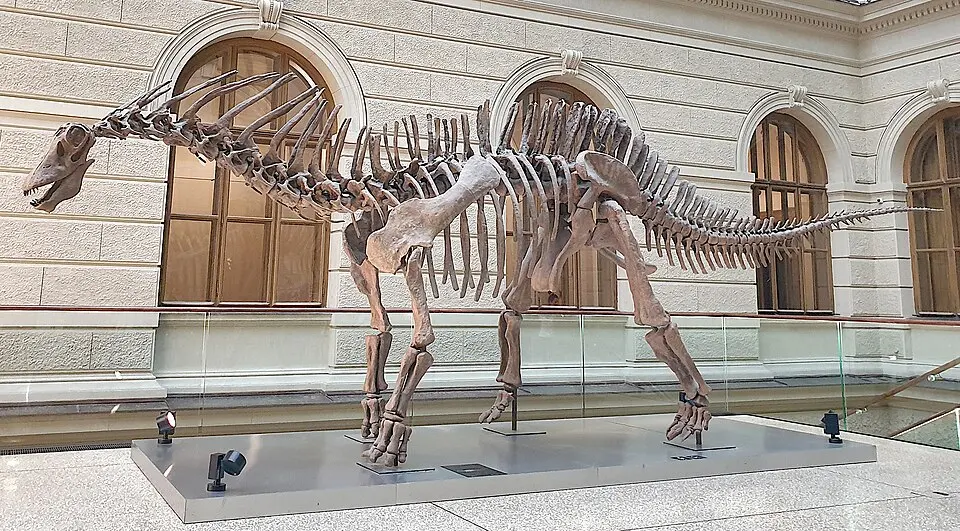
It is known from a single, fairly complete skeleton found in 1984, so details like its body size are estimated from that one individual.
DinoVerse· Amargasaurus fact sheet
Sauropods
🌿 What did it eat?
Food: Ferns, Horsetails, Cycads, Low conifers.
Browsed on low to mid-height plants, holding its fairly short neck sloping downwards with the snout close to the ground, and nipping off leaves with pencil-like teeth before swallowing them whole.
Clues scientists use: narrow pencil-like teeth like other dicraeosaurids; CT scans of the inner ear and neck joints suggesting a downward-facing snout about 80 cm above the ground; plant fossils from the La Amarga Formation.
🗺️ Where fossils were found
La Amarga Formation, near Zapala, Neuquén, Argentina (South America)
Skeleton / museum mount of Amargasaurus: historická budova Národního muzea v Praze - západní dvorana s…
Myth or fact?
✗ Myth: Amargasaurus definitely had two big skin sails on its neck.
✓ Fact: The two rows of spines were very close together, so two separate sails are unlikely. Scientists still debate whether it had one sail, bare spikes or something in between.
✏️ Quick quiz
Circle the right answer. Name: ______________________
What was special about Amargasaurus's neck?
A It glowed in the dark
B It had two rows of tall spines
C It was the longest neck ever
D It had feathers
In which country was Amargasaurus found?
A Argentina
B China
C USA
D England
When did Amargasaurus live?
A Late Triassic
B Late Jurassic
C Late Cretaceous
D Early Cretaceous
Answers: 1–B 2–A 3–D
Sources and picture credits
Natural History Museum London — Amargasaurus — www.nhm.ac.uk/discover/dino-directory/amargasaurus.html
Wikipedia — Amargasaurus — en.wikipedia.org/wiki/Amargasaurus
 DinoVerse · Dinosaur fact sheet